Obituary: Professor Ann Barrett
Past-president of ESTRO
1943 – 2026

By Prof Roy Rampling
When in 1986 the Glasgow Institute of Radiotherapeutics planned to expand its academic department of radiotherapy, it was no surprise that its leaders looked to Ann Barrett to be its academic lead. Her interest in novel radiotherapy approaches, which included the total body irradiation technique, matched that of the leaders at the institute, who had been instrumental in developing similarly novel approaches such as mantle and inverse ‘Y’ for Hodgkin’s disease. As a world authority on the management of paediatric tumours and sarcoma, she brought with her an interest in radiobiology and particularly in the late effects of radiation, which led to a very fruitful research collaboration with the late Professor Tom Wheldon. In addition, she had a formidable reputation as a teacher, and by that time her book, Practical Radiotherapy Planning, which had been published in collaboration with Dr Jane Dobbs, was established as essential reading for trainees in oncology. The institute was delighted by her appointment.
Ann was a great believer in specialisation in oncology when radiation oncologists were largely site generalists. As well as being academic lead, she took on the role of clinical director of the newly named Beatson Oncology Centre as a means of encouraging her staff to site specialise. With Professor Stan Kaye, she created the organisational conditions to enable them to achieve this in a way that was familiar from her Marsden experience but was present in few other centres at that time. In the process, she established a world-class paediatric oncology practice, which formed the basis of her clinical research.
In the 1980s, radiotherapy training was piecemeal and unstructured. Ann introduced the UK’s first MSc in clinical oncology, and this move encouraged not only trainee doctors but nurses and medical physicists to obtain formal training and an additional qualification in the discipline. This model was widely copied across the UK.
Ann was also a very social and sociable person. As well as offering frequent invitations to her house for parties or dinners, she introduced annual gatherings at Rusacks Hotel in St Andrews, where trainees from all over Scotland would meet for a few days of formal oncology education but also to eat well, drink well and create friendships. In this environment, she was at her happiest.

Prof Roy Rampling
Professor Emeritus Glasgow University, UK
Pictures from the St Andrews Oncology course in 1996:

Ann talking radiobiology with Tom Wheldon on the sands at St Andrews.

Ann leading a group of students on a Pier walk at midnight.
Two ESTRO Presidents in Glasgow.
Thank you, Prof Barrett, for your enduring ESTRO inspiration
By Prof Barbara Jereczek-Fossa
As a young resident in radiation oncology, I had the privilege of spending several months at the Beatson Oncology Centre in Glasgow, UK, through the Erasmus-Tempus Programme. There, I trained under Ann Barrett, Professor of Clinical Oncology at the University of Glasgow.
That period shaped me profoundly. It was in Glasgow, and thanks to Prof. Barrett, that my passion for oncology, and especially for radiation oncology with an international ESTRO perspective, began.
Prof Barrett was known for her love of languages and communication, and for her commitment to education. Having spent time in France before moving to Glasgow, she strongly believed in international ESTRO collaboration and served as ESTRO President in the late nineties.
My months in Glasgow were intense and formative, involving clinical work and research within national and international trials. Prof Barrett had a special dedication to young patients and rare tumours, such as sarcomas, always promoting a multidisciplinary approach. Evening hospital ward rounds with her, and the way she spoke with patients, were powerful lessons in both humanity and professionalism.
She worked tirelessly, yet also showed me the importance of balance. Her “days off” (as she called them) in the Scottish Highlands left a lasting impression. Even today, I try to preserve that balance between time “on” and “off,” which is not always easy, but is essential in such demanding times.
Returning to Glasgow in 2024, where my ESTRO Presidency was announced during the ESTRO Congress, was perhaps a coincidence, yet it felt like a quiet tribute to Prof Barrett and all she inspired.

Prof Barbara Jereczek-Fossa, Milan Italy
ESTRO President-Elect

By Dr H Jane Dobbs
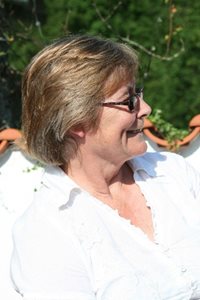
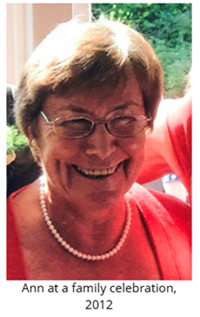
Ann on holiday, 2010
I first met Ann standing in the cafe queue at the Royal Marsden Hospital, Sutton - it was 1977 in the days when clinics stopped for coffee. I was a brand-new junior trainee Oncology registrar. I asked Ann if she was a new trainee too. “It’s my first week here too” she replied, and we started chatting. Sometime later that week I discovered that Ann was indeed new to the Marsden, but as a Senior Lecturer on the Professorial Unit, not a junior trainee registrar! For me this first encounter shows something of what made Ann so special; her humility and her kindness and compassion. As I rotated around the various Oncology training teams at the Marsden, I soon decided that Ann was the role model to which I would aspire. She became both a mentor and a lifelong friend.
Ann was a first-class clinician, an acute listener and a clear, concise and kind communicator of news that was often difficult and not infrequently bad. Ann taught us both highly academic, evidence-based medicine and practical clinical skills, modelling empathy and sensitive rapport with her patients.
During her years at the Royal Marsden Hospital as Senior Lecturer and then Consultant in Paediatric Oncology, Ann developed the Total Body Irradiation Unit as well as running the Professorial Unit. Ann had a stellar career as a Paediatric Oncologist and enjoyed the freedom of working across the specialist boundaries. She was a popular chair of numerous committees as she showed both wisdom and patience and could be relied upon to see both points of view and had facilitating skills worthy of a diplomat.
Despite this eminence and numerous senior international roles, and awards including an OBE in the UK, Ann never sought the limelight.
Ann and I went on to write 4 editions of a textbook of “Practical Radiotherapy Planning” together, with many a happy hour spent researching and writing interspersed with long walks, another of Ann’s passions. The book became popular and opened the door to teaching on many ESTRO courses in Europe, as well as in Asia, where we met many wonderful international students and visited some beautiful places. Ann delighted in telling me recently that she earned £2.76p in the latest royalties from the book!
Ann also had a gift for joy. She loved a celebration and knew how to throw a party apparently effortlessly, just as she generously helped others to do the same.
Ann and I shared the ups and downs of life, and her wisdom was always thoughtful and deep, and usually right! We also shared a deep faith in Jesus, and it has been a true privilege and blessing to walk as pilgrims together over these past 49 years.
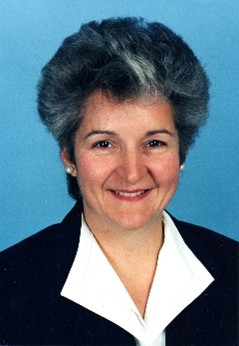
Dr H Jane Dobbs
ESTRO Course teacher (1985-2005)
London, UK
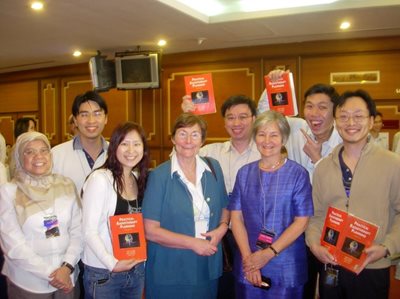
Teaching course 2007. Students with textbook
" Practical Radiotherapy Planning ". Ann and Jane in the centre.
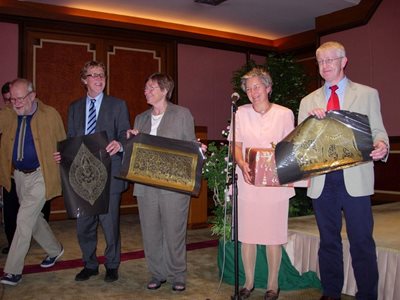
ESTRO Teaching Course 2005
Left to Right: Torsten Landberg, Ben Mijnheer, Ann Barrett, Jane Dobbs, Brendan Carey
By Adrian Harnett
It must be fairly unusual for a colleague to have such a huge impact on one’s life but that is the case with Ann Barrett. She was brave enough to appoint me to my first consultant post in Glasgow in 1988 and remarkably 14 years later did the same for me in Norwich. I therefore have had the privilege of working with her for 20 years but that is only half the story.
Ann became a close friend, confidant, adviser, defender, godmother and much much more. She supported me during the challenging first years of being a consultant, including the sudden death of our first child from meningococcal septicaemia at the age of 3. As happened in her paediatric practice Ann was prepared to be beside grieving parents and by so doing took on and shared some of their pain. It was brave, it cost her but she did it. It even included home visits to mourning families. After work and for several years she would go home and carry out dressings for her father’s ulcerated legs. In fact she ensured he had accommodation beside her in both Glasgow and Norfolk.
Ann encouraged and supported me throughout my career from discussing clinical cases, teaching and holding courses, research and publications and career progression. In all these ways she truly moulded me. She even volunteered and excelled at mundane tasks such as proof reading - remarkable for such an accomplished and gifted person. Nothing was beneath her, she looked down on nobody as shown in not just her clinical practice but in her voluntary work in Cambridge helping those with mental health illness, addiction and homelessness.
It was a great surprise to Ann when she was awarded an OBE and, typical of Ann, there was no way that she was going to be thwarted from tracking down those
responsible to thank them. She was delighted with the honour but we thought she should really be a Dame.
Ann loved children and was godmother to our second daughter Katie. We shared family holidays particularly in her beloved Scotland and France. Sally and I will be forever grateful for her, thankful that her year long suffering is over and that she is now with her and our Lord and Saviour.

Ann’s last visit to Scotland 2025
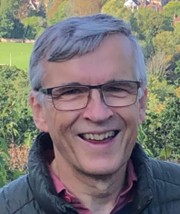
Dr Adrian Harnett
Consultant Clinical Oncologist
Norwich, UK
By Prof Jean-Pierre Gérard
I heard with great sadness that Ann Barrett has passed.
She was ESTRO President just before me, and we shared a very close relationship and friendship. We were both fully dedicated to the development of our still-young Society in the spirit of the creative pioneer, Emmanuel van der Schueren. It was around the years 1999–2000, and if I remember correctly, ESTRO had only around 1,000 members back then in Edinburgh.
Just before the transition of the presidency, we met for a private discussion, and I asked her:
"Ann, taking advantage of your experience as ESTRO President, what can we do to strengthen the efficiency of ESTRO within the global oncology environment?"
She replied: "Jean-Pierre, I believe that Emmanuel created a European Society based on individual participation, and we should try to reinforce this democratic strategy by listening closely to the requests of our members. Emmanuel also demanded scientific evidence, and we must highlight the academic achievements of European radiation oncology. As a British academic, I agree that the Palace of Westminster and our universities in Oxford and Cambridge are good examples of what we can do to follow the ESTRO spirit."
My answer was likely, "God Save the Queen!" and today I will add, "…and bless you, dear Ann!"

Prof Jean-Pierre Gérard, Lyon, France