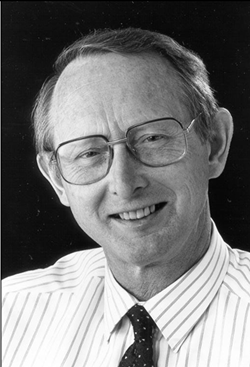
Professor Gordon Steel
Sadly, we must let you know that Professor Gordon Steel DSc died from recurrent oral cancer in December 2025, aged 90. He was a leader in the radiobiology community through his research, mentorship and teaching, most notably as course director for the ESTRO Basic Clinical Radiobiology Course.
He was born in Lee-on-Solent but broughtup in Knaresborough, Yorkshire, UK, and read Physics at Birmingham University, also in the UK. He first joined the Institute of Cancer Research (ICR) in London, UK, as a PhD student in 1957 and remained there until the end of his career. In his personal life, he was a leading member of the religious group the Quakers in Sutton, south of London. There, he met Patricia Holland, and they married in 1959. He was a dedicated family man with three children, one of whom followed him into scientific research.
After his PhD, in his continuing work at the ICR, Steel established that loss of cells as they died was a crucial factor in the growth of cancerous tumours - revealing that the growth of a tumour depended on the balance between new cell production and the loss of cells. This balance indicated how aggressive a tumour was, and Steel’s discoveries laid the foundations for research into new treatments that targeted the processes around cell death to limit the growth and spread of a cancer. Steel made another important research contribution, with Professor Sir Michael Peckham (1935-2021), into the interactions between radiotherapy and chemotherapy. Steel’s foundational research into the biology of radiation continues to inspire scientific efforts to make radiotherapy more effective by combining it with other cancer treatments.
Steel leaves behind a profound legacy that has shaped modern cancer treatment and influenced generations of scientists and clinicians worldwide. He dedicated his professional life to the pursuit and evaluation of new approaches to cancer therapy, primarily in the London academic and research community. The unique setup at the ICR and Royal Marsden Hospital, in which the research laboratory was connected directly to the hospital setting, allowed him to expertly bridge the gap between fundamental research – investigating tumour-cell kinetics, DNA damage and repair, and cellular radiosensitivity – and practical clinical application.
The Growth Kinetics of Tumours
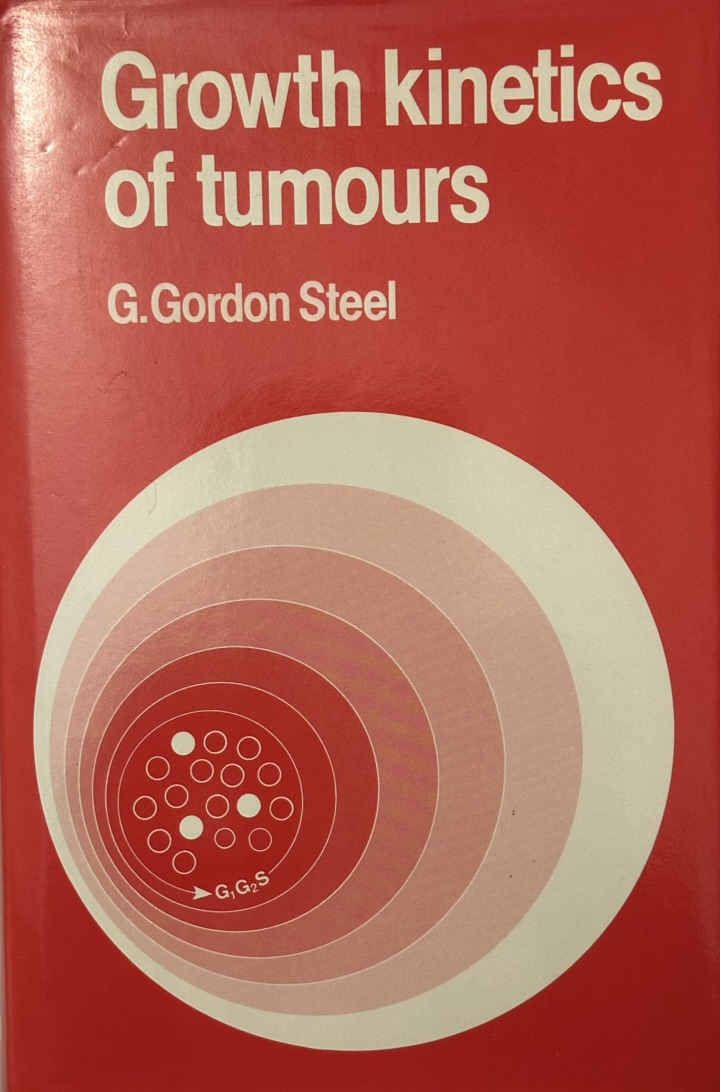
By the early 1960s, Steel had decided to take an interest in cell proliferation in tumours. Gradually, he developed an overview of the whole field. One specific interest was in the role of cell loss from tumours as a determinant of how fast tumours grew. By 1975, he felt able to write a book about this whole field. Growth Kinetics of Tumours was a great labour that absorbed a lot of time. Oxford University Press agreed to publish it; it became well known within the field and was on the prescribed reading list for British radiotherapy students until it went out of print. As far as we know, it has not been superseded and has been cited 1685 times by other scientists. The Wellcome Collection holds a video, recorded in 1974 and available online, of Steel and colleagues lecturing on “Biology of cancer: cell proliferation”.
Clinical Radiobiology
Steel led the Biophysics Unit at the ICR until 1974, when Peckham invited him to join the radiotherapy section, and the team was renamed the Radiotherapy Research Unit. Radiobiology research became more focused on clinical objectives, and particularly on radiotherapy and chemotherapy interactions. Steel and Peckham jointly published Exploitable mechanisms in combined radiotherapy-chemotherapy: the concept of additivity in 1979, which, with 1,117 citations, became a “citation classic” in 1988. In 1980, Steel was awarded the prestigious position of professor of radiobiology applied to radiotherapy at the ICR, a role he held until his retirement in 2002.
Mentorship and Teaching
Steel led the Radiotherapy Research Unit for 25 years and was a dedicated mentor to about 30 junior oncologists and scientists, who worked for MD or PhD research degrees. Many of these research fellows went on to become leaders in the field of oncology and to hold senior clinical and academic positions around the world. This “team science” approach was highly productive, with Steel contributing over 300 peer-reviewed publications. Another result of the clinical-scientific collaborations was the foundation of the ESTRO Basic Clinical Radiobiology Course, which continues to this day. The course was multidisciplinary and designed for radiotherapy, medical physics and radiobiology specialists in training. Steel organised his first course in Granada, Spain, in 1990. In the same year, he was awarded the prestigious ESTRO Breur award by Emmanuel van der Schueren. The popular course continued annually under his leadership as course director until he passed on the baton to colleagues Bert van der Kogel and Mike Joiner in 1999. They had both been founding teachers on the course, and Prof. Joiner had been one of Gordon’s PhD students.
The course inspired Steel to produce and edit the seminal textbook Basic Clinical Radiobiology on behalf of ESTRO. The first edition was published in1993 with subsequent editions in 1997 and 2002. The text became required reading for UK Fellowship of the Royal College of Radiologists candidates and is an essential companion to everyone involved in radiation oncology, with international reach into academic cancer centres. Editorship continues with Profs Joiner and van der Kogel with a sixth edition published in 2025.
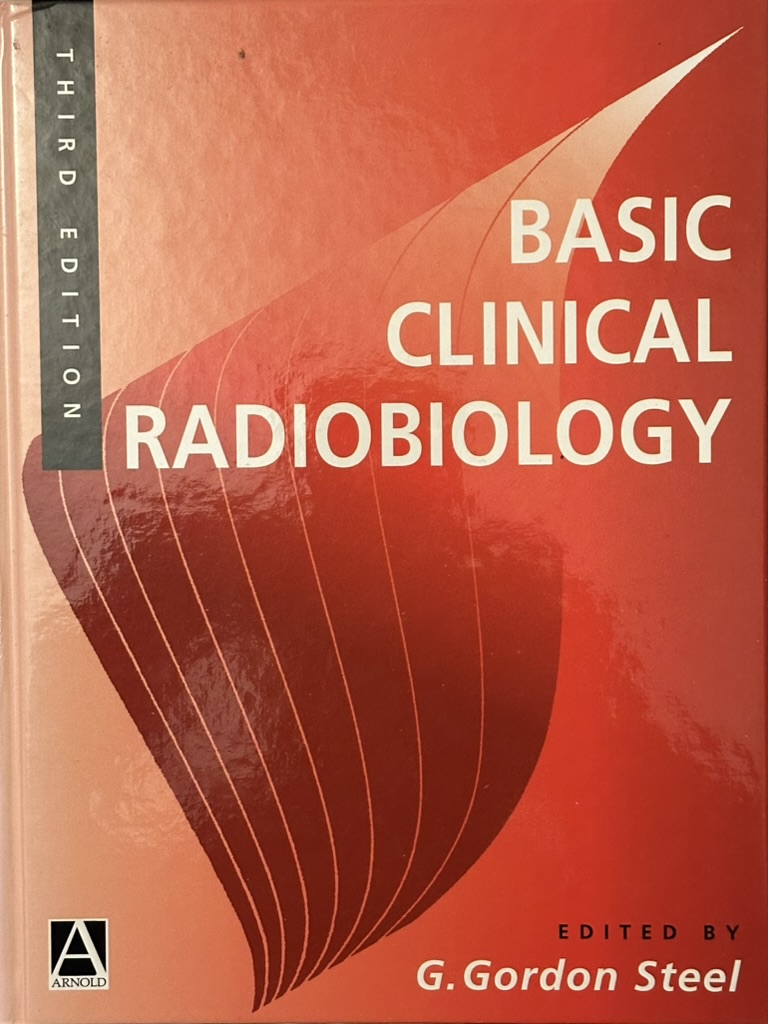
Post-retirement, Steel became the Emeritus Professor of Radiation Biology at the ICR, but gave most of his attention to his family and the Sutton Quakers. He is remembered as a tall, energetic man, quick to laugh. He stalked the corridors of The Institute well after his ‘official’ retirement and always treated everyone from porter to professor equally. One former colleague at the ICR noted: “Even after all this time, despite his eminence in his field of cancer radiobiology, I remember him fondly and am grateful for the kindness, patience, and generosity he showed to me in my early years at the ICR.”
Hilary Steel and Professor David Dearnaley, Emeritus Professor of Uro-Oncology, ICR with contributions from Steel’s colleagues at the ICR