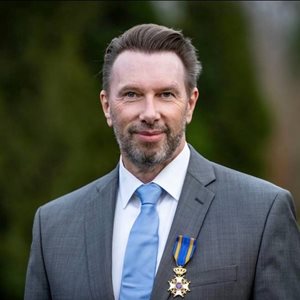
Professor Ben Slotman has been a towering figure in international radiation oncology. From his early days as a clinician and researcher in Amsterdam, The Netherlands, to his leadership roles on the global stage, including serving as ESTRO president from 2020 to 2022, his career has been marked by vision and dedication, and he has had a lasting impact on the field.
Recently, a farewell symposium at Vrije Universiteit Amsterdam celebrated his remarkable contributions, and he was honoured with a prestigious Royal Dutch distinction, Knight of the Order of the Netherlands Lion. This honour was given in recognition of his outstanding achievements in radiation oncology and international collaboration.
In this interview, Prof Slotman shares insights from his time leading ESTRO, memorable moments in his career, and his thoughts on the future of radiation oncology.
Prof Slotman: Looking back, what do you hope your impact on the radiation oncology community will be remembered for?
I am most proud of the ability we had in our department to be among the first centres to implement new technologies. These included stereotactic body radiation therapy, volumetric-modulated arc therapy and MR-guided radiotherapy. This requires a team with the best players and a clear and common objective. Once implemented in a department, these techniques need to be disseminated to the whole community. The work requires a combination of vision (what will be “hot” in the future), organising things and getting the equipment, doing the required research and educating and training others. This mixture makes it so interesting and challenging.
What accomplishments during your presidency are you most proud of? Any particular projects or initiatives that were especially meaningful?
My presidency coincided with the COVID pandemic. A large part of the work during my term was related to the effects of the pandemic on our Society. ESTRO has low membership fees in comparison with most other organisations within our field, and the income from the annual meeting is crucial to pay the bills. The moment a meeting is delayed or cancelled, the flow of money comes to a halt, which, of course, creates many problems.
The COVID pandemic also forced us to use online Board and committee meetings. This was a great benefit, as I am a strong supporter of more frequent, shorter meetings, and in an international organisation, you can only do this online. This also allows more people to participate in the discussions and decisions.
Another important point was that I tried to make ESTRO more transparent and more open to new colleagues, a process that had already started under the leadership of Umberto Ricardi.
Were there any initiatives you started that you hope will continue to shape ESTRO’s future?
When I rotated off as past-president and mentioned that I would remain available for smaller jobs, I was asked to set up a mentoring programme in the field of lung cancer. In January 2024, we initiated a two-year programme with 1:1 mentoring for 15 young colleagues in the field of thoracic oncology. The project is very successful and could be used as a model for other disease sites as well.
How did you navigate balancing your international responsibilities with management, research, teaching, and patient care at Amsterdam UMC?
There are 24 hours in a day, and when you accept a new task with an agenda that is already full, you have to compromise somewhere. It’s important to have good people who can work independently, and you shouldn’t be a micro-manager: not in your department and not in the organisations you work in. Besides, these extra tasks often give me a lot of satisfaction and energy back, so it’s an investment that pays off.
ESTRO is a community as much as a Society. How did you approach engaging and inspiring members across Europe and beyond?
I think that the way we constructed the ESTRO focus groups is a good way to have a very diverse participation from all of Europe. In addition, the big success of the annual meeting in recent years in attracting the best abstracts and publishing them during the meeting in high-ranked journals is a great way to get global exposure. I am very happy to see how well ESTRO is doing at the moment.
Looking back, are there any memorable encounters with young professionals that shaped your view of mentorship?
I always like the discussions with residents in visiting professorships abroad. You speak for one or two hours with a group of young colleagues whom you’ve never seen before about your career and their aspirations and challenges. It gave me a lot of insight into their experiences and perspectives, and it’s also very nice to hear many years later that some still remember it and have followed some of my advice. I think it’s important to be both a role model and a colleague who has gone through the same issues in the past.
How do you see the role of international collaboration evolving in our field?
Collaboration between societies is crucial to avoid too much overlap and competition in activities and to speak with one voice as a radiotherapy community. That was one of the reasons to start IRON, the International Radiation Oncology Society's Network. This also offers a better basis for projects to improve radiotherapy availability and access on a global level.
What exciting projects or goals are you looking forward to in the coming years?
I hope to continue with the tasks I’m currently performing in committees and boards of various organisations. I’m also still involved in projects on international guidelines in small-cell lung cancer.
For the remainder, I have no well-defined plans. But when a new opportunity comes around, I’ll definitely evaluate it. That’s the beauty of this new phase of life: doing the things you like most.