ESTRO course report
15-19 March 2026, Málaga, Spain
Course directors: Tony Lomax (Switzerland) and Beate Timmermann (Germany)
I am Jaime Reverter Pérez, a medical physics trainee at the Hospital do Meixoeiro in Vigo, Spain. In March 2026, I had the opportunity to attend my first ESTRO course. I decided to join this course because of my strong interest in the field of particle therapy, and because it had been highly recommended to me by colleagues who emphasised its scientific quality.
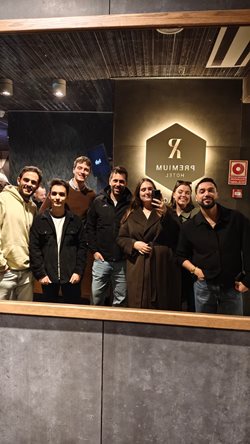
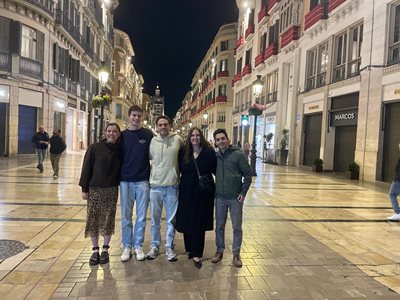
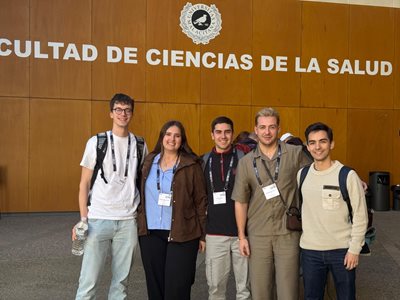
In my opinion, the course had a well-balanced timetable that allowed for intensive learning while still leaving space for discussion and interaction. Therefore, it was easy to connect with participants from different countries and backgrounds in a dynamic environment. Beyond the academic value, the experience was also personally enriching: meeting new people, sharing experiences and enjoying Málaga made the course truly memorable.
The programme offered a comprehensive and multidisciplinary overview of particle therapy, covering fundamental aspects such as physical principles and radiobiology, as well as its clinical implementation. Although proton therapy was the main focus, other ions such as carbon were discussed, as well as emerging options like helium and oxygen. Key topics included proton therapy techniques, imaging, clinical indications and future developments. One particularly interesting feature was the one-day partial separation of sessions for physicists, which offered topics such as dosimetry and quality assurance, and clinicians, who explored different clinical indications, while maintaining a shared understanding of the field. Overall, the programme effectively bridged technical and clinical perspectives.
One of the most remarkable aspects was the level of interactivity. The faculty included leading experts in particle therapy from around the world, all of whom were approachable and open to discussion (even during coffee breaks). This created a special opportunity to ask questions and to engage directly with specialists at the forefront of the field. I found this particularly valuable, as it allowed me to deepen my understanding of complex topics and to gain insights beyond standard lectures.
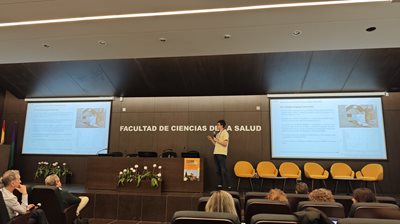
The course also encouraged active participation and presentation of clinical cases from students for discussion. I had the opportunity to present a portable graphite calorimeter from Radiophysics Laboratory of University of Santiago de Compostela, which has an interesting use for reference dosimetry in proton therapy.
Having previously completed an externship at the Centro di Protonterapia di Trento (Italy), I already had some background in the subject. However, this course provided a structured overview that helped me to connect concepts and better understand the broader clinical and technical context. It is an excellent course both for newcomers and for those looking to expand their knowledge.
Among the key takeaways, I would highlight the versatility of proton therapy as a treatment modality and its growing relevance, particularly with the development of new proton therapy centres in Spain. The course emphasised the distinct physical and technical challenges compared with conventional photon-based techniques, opening the door to new research opportunities. This field offers significant potential for innovation and professional development.
In conclusion, I would strongly encourage anyone interested in particle therapy to attend this ESTRO course. Beyond the high-quality scientific content, it is an opportunity to connect with a global community, exchange ideas and be inspired by the latest advances. My experience in Málaga was both educational and enjoyable, and I look forward to participating in future ESTRO activities.
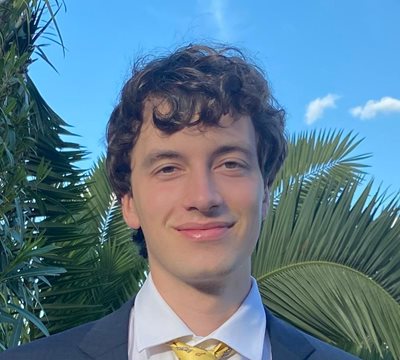
Jaime Reverter Pérez
Medical physics trainee
Hospital do Meixoeiro
Vigo, Spain
jrp860@gmail.com