The first impression I gained after I started treating patients independently was not triumph. It was pure, distilled chaos.
No matter how good the training period has been, the first patients you manage on your own feel different. You double-check everything. Then you check it again. You question your contours, your dose prescriptions, your decisions and sometimes your judgement. Responsibility feels heavier the moment it truly becomes yours. At times, in those first weeks, it felt almost like a matter of personal sanity.
But slowly, something shifts. You realise that becoming a specialist does not mean suddenly feeling certain all the time. It does not mean having every answer immediately or carrying every difficult case alone. What changes instead is the way you learn to hold uncertainty. You begin to understand that responsibility is real, but so is support.
One of the most important lessons for me was recognising how much of patient care is built by the team around us. The people who shape a patient’s journey through the department are not just part of the process; they are its backbone. From colleagues in the multidisciplinary team to medical physicists, radiation therapists, and nurses, everyone is caring for the same patient, each in their own way, each bringing something essential. That is where much of my courage came from.
Another important part of this transition is looking beyond your own department. Involvement in early-career programmes can be incredibly valuable for young radiation oncologists. These opportunities widen perspective, expose us to new ways of thinking, and broaden our understanding of what radiotherapy can and should be. They remind us that our professional identity is not formed only by our local routine, but also by the wider conversations happening across Europe.
This matters because young specialists need more than technical training alone. We need context, we need exchange – we need to see how others work, how they think, how they approach complexity, uncertainty and innovation. Early-career initiatives help to build that wider horizon. Mentorship plays a special role here. A good mentor does not eliminate uncertainty but helps to make it manageable. Mentorship programmes can help young radiation oncologists to integrate better into both local and other European professional networks, and perhaps most importantly, they make it easier to ask for help when difficult cases arise. That may sound simple, but it is not a small thing. In a field as demanding as radiation oncology, knowing when to ask for advice is not a weakness – it is a responsibility.
This transition also teaches another difficult but necessary lesson: a deep belief in the power of radiotherapy must go hand-in-hand with an understanding of its limits.
As young specialists, we are often driven by the desire to cure, to offer the best, the newest and the strongest treatment. And rightly so. However, professional maturity also means recognising that sometimes a palliative treatment is not a lesser option, but the right one. Relief of symptoms, preservation of dignity and support at the right moment are also meaningful forms of care. Learning to recognise the boundary between what is technically possible and what is truly appropriate is part of growing into this role.
With that comes another central responsibility: respecting the patient’s decision. We may know the data, the guidelines and the latest studies, but patients are not passive recipients of our knowledge. They are partners in decisions that will affect their lives directly. Our role is to explain clearly, to support honestly and to help them to understand both the possibilities and the limits of treatment. When a patient makes an informed decision, even if it is not the one we would have chosen ourselves, we must be able to respect it.
Looking back, the shift from resident to specialist was not a clean transition from fear to confidence. It was more complicated than that. More human. More demanding. But also more meaningful. What I understand now is that confidence in this profession is rarely built by itself. It grows through teamwork, through mentorship, through early involvement in the wider professional community and through our humility to recognise both the power and the limits of what we do.
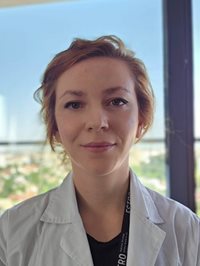
Daniela-Lidia Sandu
Department of Radiation Oncology, OncoHelp Cancer Centre
‘Victor Babes’ University of Medicine and Pharmacy
Timișoara, Romania
Email: sandudanielalidia@gmail.com