ESTRO 2026 Urology highlights
ESTRO 2026 congress report
Report by the ESTRO Urology Focus Group
- Pelvic radiotherapy in patients with very high-risk localised prostate cancer: results of the PEACE 2 phase III randomised trial
Interdisciplinary track I Proffered Papers Session
For decades, radiation oncologists have debated whether elective pelvic nodal irradiation should be routinely incorporated into the treatment of patients with very high-risk localised prostate cancer. While occult nodal micrometastases are thought to contribute to disease recurrence and metastatic progression, convincing evidence that prophylactic pelvic radiotherapy improves long-term outcomes has remained elusive.
At ESTRO 2026, Prof. Pierre Blanchard, France, Principal Investigator, presented the mature results of the PEACE-2 phase III randomised trial, providing one of the longest follow-ups available to address this important clinical question.
PEACE-2 enrolled patients with conventionally node-negative but very high-risk localised prostate cancer, a population characterised by a substantial risk of harbouring microscopic nodal disease despite negative imaging. The majority of patients (82%) fulfilled the STAMPEDE definition of very high-risk disease, while nearly 40% had an estimated nodal involvement risk exceeding 35% according to the Roach formula. Although next-generation imaging was not routinely available at the time the trial was designed, choline PET/CT was used in approximately 18% of patients.
The study employed a 2×2 factorial design evaluating the addition of pelvic radiotherapy and Cabazitaxel to standard treatment. As no interaction was observed between the two interventions, outcomes were analysed according to radiotherapy field allocation.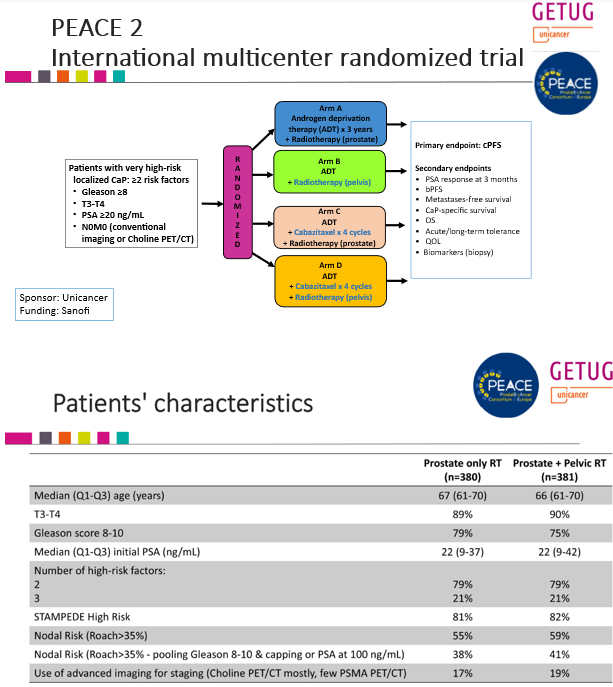
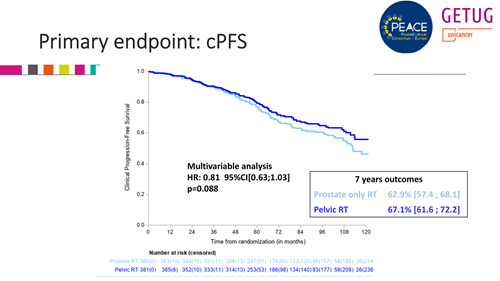
After a remarkable median follow-up of more than seven years (87 months), the results painted a nuanced picture. Elective pelvic irradiation was associated with a trend towards improved clinical progression-free survival, reducing the risk of clinical progression by approximately 19% (HR 0.81, 95% CI 0.63–1.03; p=0.088). At seven years, clinical progression-free survival reached 67.1% with pelvic radiotherapy compared with 62.9% in patients treated to the prostate alone.
However, the apparent gain in disease control did not translate into improvements in the endpoints that matter most to patients. No improvements were observed for biochemical progression-free survival (HR 0.84), metastasis-free survival (HR 0.90), cancer-specific survival (HR 0.95), or overall survival (HR 1.21). Five-year overall survival rates were excellent and nearly identical between treatment groups, reaching 91% and 92%, respectively.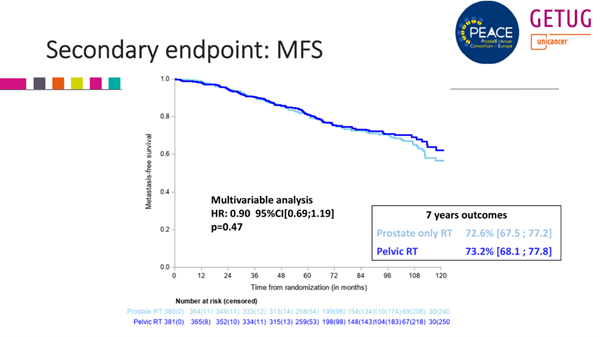
Equally noteworthy was the safety profile. Despite concerns that larger treatment volumes could increase toxicity, pelvic irradiation was delivered without a significant excess of late adverse events, highlighting the ability of modern radiotherapy techniques to safely treat nodal volumes in the postop setting or in case of N1 disease.

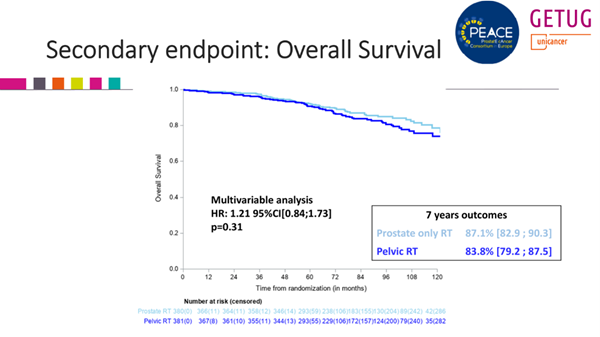
During his presentation, Prof. Blanchard emphasised that the findings should be interpreted in the context of rapidly evolving imaging technologies and systemic treatment intensification strategies. While elective pelvic irradiation appeared to delay clinical progression modestly, the study provides no evidence that this approach alters the natural history of the disease by reducing metastatic spread or improving survival.
The PEACE-2 findings are particularly noteworthy when viewed alongside the companion analysis evaluating treatment intensification with Cabazitaxel, presented at ASCO GU 2026. Despite more than seven years of follow-up, Cabazitaxel failed to improve clinical progression-free survival, metastasis-free survival, or overall survival and was associated with increased toxicity. Taken together, these analyses suggest that neither elective pelvic irradiation nor chemotherapy intensification substantially improves long-term outcomes in patients with conventionally staged very high-risk localised prostate cancer.
Perhaps the most thought-provoking message from PEACE-2 is not the lack of benefit from either intervention, but rather the unexpectedly favourable outcomes observed across all treatment arms. Nearly 90% of patients were alive nine years after treatment, despite fulfilling contemporary definitions of very high-risk disease. These excellent long-term results raise important questions about current risk stratification and whether patients classified as “very high-risk” in the conventional imaging era truly represent the population most likely to benefit from treatment intensification.
The PEACE-2 trial, therefore, adds an important piece to the complex puzzle of pelvic nodal treatment in prostate cancer. Although elective pelvic radiotherapy remains biologically appealing and can be delivered safely with modern techniques, its routine use in conventionally node-negative, very high-risk disease cannot be justified on the basis of improved metastasis-free or overall survival. Future studies incorporating PSMA PET staging and contemporary systemic therapies will be crucial to identify the patients most likely to benefit from nodal irradiation.
Take-home message: After more than seven years of follow-up, PEACE-2 demonstrated a borderline improvement in clinical progression-free survival with elective pelvic radiotherapy, but no significant benefit in metastasis-free survival, cancer-specific survival, or overall survival. More importantly, the study highlights the excellent outcomes achieved with contemporary radiotherapy and long-term androgen deprivation therapy, while underscoring the need for more precise identification of patients who truly require treatment intensification.
Prof Thomas ZILLI
Department of Radiation Oncology
Oncology Institute of Southern Switzerland, EOC
Bellinzona, Switzerland
ESTRO Urology Focus Group Core Expert

Reference
1 Pierre Blanchard, Stéphanie Foulon, Xavier Artignan et al. Pelvic radiotherapy in patients with very high-risk localized prostate cancer: results of the PEACE 2 phase III randomized trial.
Presentation Number: 5520
- Hypofractionated radiotherapy after radical prostatectomy again yields controversial results!
Clinical track I Proffered papers
In the management of biochemical recurrence following radical prostatectomy, considerable controversy remains regarding the safety of moderate hypofractionation, owing to the limited availability of robust long-term data. During ESTRO 2026, the SHARE phase III randomised trial was presented, evaluating whether hypofractionated salvage radiotherapy (HYPO) could improve outcomes compared with conventional fractionation (CONV) in patients experiencing biochemical recurrence after radical prostatectomy. Between 2019 and 2021, 299 patients were randomised to receive either 65 Gy in 26 fractions (EQD2 = 74.3 Gy) or 66 Gy in 33 fractions, with 295 patients ultimately included in the analysis. Treatment was delivered to the prostate bed using intensity-modulated radiotherapy and daily image guidance, while androgen deprivation therapy and elective pelvic nodal irradiation were administered at the discretion of the treating physicians. The primary endpoint was biochemical progression-free survival (bPFS), with secondary endpoints including distant metastasis-free survival (DMFS), cancer-specific survival (CSS), toxicity, and patient-reported quality of life.
After a median follow-up of 52.6 months, the study demonstrated no significant difference in oncological outcomes between the two treatment arms. Four-year bPFS rates were comparable, reaching 80.1% in the HYPO group and 78.1% in the CONV group (p = 0.88). Similarly, DMFS and CSS rates were nearly identical. These findings indicate that hypofractionation did not provide superior disease control but achieved efficacy comparable to that of conventional treatment schedules. It is important to emphasise that SHARE evaluated not only hypofractionation but also a dose-escalation strategy, with an EQD2 of 74.3 Gy in the experimental arm. The results, therefore, further support the findings of two previous randomised studies demonstrating the lack of oncological benefit from dose escalation in the salvage setting.
To date, only the NRG-GU003 trial has evaluated hypofractionation in a phase III randomised design, and its relatively short follow-up has made the widespread adoption of moderate hypofractionation debatable; the SHARE study is therefore of considerable interest. The 4-year cumulative incidence of grade ≥2 gastrointestinal (GI) toxicity was significantly higher in the HYPO arm (8.0% versus 0.7%, p = 0.003). Interestingly, a subgroup analysis of patients treated with an endorectal balloon was also presented. Among patients who did not receive an endorectal balloon, the rate of grade ≥2 GI toxicity increased to 15.3% and 1.9% in the HYPO and CONV arms, respectively (p = 0.02). Conversely, the use of an endorectal balloon appeared to reduce the cumulative incidence of grade ≥2 GU toxicity in both treatment arms. Importantly, patient-reported quality-of-life outcomes did not differ significantly between groups… with a short follow-up!
Once again, following this study, hypofractionated radiotherapy after radical prostatectomy remains a controversial topic, and additional long-term data are needed before this approach can be considered a standard of care for all!

Dr. Paul Sargos
Amethyst Radiotherapy Group
La Garenne-Colombes, Paris, France.
E-mail: paul.sargos@amethyst.fr
ESTRO Urology Focus Group Core Expert
- Implementation of an RTT-led workflow for prostate GTV delineation at the MR-linac
Speaker: Eline de Groot-Breugel, RTT UMCU, Utrecht, the Netherlands
Session on RTTs leading innovation in radiotherapy
RTT track I Proffered Papers Session
One of the most interesting proffered papers presented in the RTT track focused on the continued evolution of RTT-led adaptive radiotherapy workflows and provided a compelling example of how the role of Radiation Therapists (RTTs) is expanding within modern radiotherapy practice. The presentation performed by Eline de Groot-Breugel, RTT from the University Medical Centre Utrecht, addressed RTT-led gross tumour volume (GTV) delineation for MR-guided prostate radiotherapy, demonstrating that responsibilities traditionally reserved for radiation oncologists can be safely and effectively transferred to appropriately trained RTTs.
Over the past decade, the radiotherapy profession has witnessed a gradual but significant shift in responsibilities. Initially, task shifting primarily involved the delineation of organs at risk (OARs), allowing radiation oncologists to focus on more complex clinical decision-making. As RTT expertise and confidence increased, several centres successfully implemented RTT-led clinical target volume (CTV) delineation, particularly within online adaptive radiotherapy workflows. This study, presented at ESTRO 2026, illustrates the next step in this progression: RTT-led delineation of the GTV itself.
The study originated from a department where MR-Linac-based prostate treatments requiring online GTV delineation have become routine, including patients enrolled in the TURBO and HypoFLAME III trials as well as selected salvage radiotherapy cases. Traditionally, these workflows required the presence of a radiation oncologist at every treatment fraction to perform or approve GTV delineation. Recognising both the increasing expertise of RTTs and the need to optimise workflow efficiency, the department explored whether RTTs could assume this responsibility within a structured training and quality assurance framework.
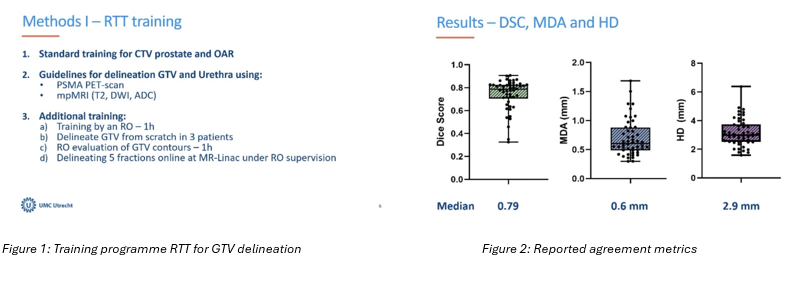
To prepare RTTs for this advanced role, delineation guidelines were developed collaboratively with radiation oncologists, incorporating information from multiple imaging modalities, including multi-parametric MRI and PSMA PET imaging. RTTs participating in the project were already experienced in delineating the prostate CTV, bladder and rectum within an established RTT-led adaptive workflow. Additional training consisted of a focused educational session on the interpretation of PSMA PET and MRI sequences for accurate GTV identification and contouring. Following training, RTTs completed retrospective contouring exercises and participated in peer-review discussions before progressing to supervised online clinical implementation, see figure 1.
The results demonstrated that RTT-led prostate GTV delineation is both feasible and clinically acceptable. Comparison of RTT-generated contours with radiation oncologist reference contours showed good agreement, with a median Dice Similarity Coefficient of 0.79, see figure 2. Variations were mainly observed in very small lesions or in situations where substantial anatomical changes occurred between fractions, such as differences in rectal filling. Importantly, the RTT-led workflow was successfully integrated into routine clinical practice, with a median treatment fraction time of 44 minutes.
These findings demonstrate that, with targeted education, robust protocols, and multidisciplinary collaboration, RTTs can undertake increasingly complex contouring tasks. As online adaptive radiotherapy becomes more widely adopted, efficient utilisation of the available workforce will be essential. RTT-led GTV delineation has the potential to reduce dependence on the continuous presence of radiation oncologists during treatment delivery while maintaining high standards of care.

Monica Buijs, MSc, Lecturer MI and RO,
Inholland University of Applied Sciences, Haarlem, the Netherlands
monica.buijs@inholland.nl
ESTRO Urology Focus Group Core Expert
- PACE-NODES: Early Toxicity Findings Support the Feasibility of Pelvic Nodal SBRT in High-Risk Prostate Cancer
Interdisciplinary track I Proffered Papers Session (latest trials)
At the ESTRO 2026 Congress in Stockholm, Dr Angela Pathmanathan (United Kingdom) presented the planned acute toxicity analysis of the PACE-NODES trial, a phase III randomised trial comparing prostate-only SBRT (P-SBRT) with prostate and pelvic nodal SBRT (PPN-SBRT) in high-risk localised prostate cancer.
Participants were randomised in a 1:1 ratio to receive either prostate-only SBRT, consisting of 36.25 Gy delivered in five fractions on alternate days, or combined prostate and pelvic nodal SBRT, consisting of 36.25 Gy in five fractions to the prostate together with 25 Gy in five fractions to the pelvic lymph nodes.
The trial exceeded its original target accrual, recruiting 1,166 patients between September 2022 and July 2025 across 47 centres. Recruitment was completed in less than three years, highlighting the strong international interest in the trial.
Baseline characteristics were well balanced between treatment groups. Nearly half of patients had T3 disease, approximately one-third had Gleason score 9–10 tumours, and most received long-term ADT. Modern staging was employed, although only 23% of patients underwent positron emission tomography-computed tomography (PET-CT) or whole-body magnetic resonance imaging (MRI), reflecting the evolving imaging landscape during the recruitment period. Notably, perirectal spacers were used in only 5% of patients, providing an opportunity to evaluate toxicity outcomes in a broadly representative real-world population.
The addition of pelvic nodal irradiation resulted in a statistically significant increase in acute gastrointestinal toxicity. Grade ≥2 GI adverse events according to CTCAE criteria occurred in 28.0% of patients receiving PPN-SBRT compared with 21.3% in the prostate-only arm, corresponding to an absolute increase of 6.7% (p=0.011). Similar findings were observed using RTOG criteria, where rates of grade ≥2 toxicity were 23.9% and 14.8%, respectively, representing an absolute difference of 9.1% (p=0.002).
Importantly, gastrointestinal symptoms followed a predictable temporal pattern. Toxicity peaked approximately two weeks after treatment in both groups and subsequently improved. By week 12, toxicity rates had fallen substantially, and no clinically meaningful differences between treatment arms remained. Severe gastrointestinal toxicity was uncommon, with grade 3 or higher CTCAE events reported in only nine patients (1.6%) receiving prostate-only SBRT and eleven patients (2.2%) receiving pelvic nodal SBRT.
In contrast, no statistically significant differences were observed in acute genitourinary toxicity. Grade ≥2 GU adverse events occurred in 40.2% of patients treated with P-SBRT and 35.8% of those treated with PPN-SBRT (p=0.14). Similarly, grade ≥2 RTOG GU toxicity was reported in 13.2% and 11.0% of patients, respectively (p=0.27). Although urinary symptoms increased transiently following treatment and peaked around two weeks, they subsequently improved in both groups. Severe GU toxicity remained rare, with grade 3 events occurring in seven patients (1.3%) in the prostate-only arm and two patients (0.4%) in the pelvic nodal arm. No grade 4 GU events were reported.
Patient-reported outcomes reinforced the clinician-reported findings. At four weeks, a significantly greater proportion of patients receiving pelvic nodal irradiation experienced a clinically meaningful deterioration in bowel function according to EPIC-26 criteria. Deterioration exceeding the Minimal Clinically Important Difference (MCID) was reported by 66% of patients treated with PPN-SBRT compared with 55% of those receiving prostate-only SBRT (p=0.003). However, no significant differences were observed in urinary irritation, urinary incontinence, hormonal symptoms or sexual function domains.
Overall, the acute toxicity analysis of PACE-NODES provides reassuring evidence regarding the feasibility of delivering pelvic nodal SBRT in a multicentre setting. While elective nodal irradiation is associated with a modest increase in short-term bowel toxicity and transient reductions in bowel-related quality of life, these effects appear limited in duration and largely resolve within three months. Equally important, the addition of pelvic nodal treatment did not increase acute genitourinary toxicity.
Giulio Francolini,
Radiation Oncology Unit
Azienda Ospedaliero-Universitaria Careggi
Florence University Hospital, Florence, Italy
Francolinigiulio@gmail.com; @GiulioFrancoli1
Member of the ESTRO Urology Focus Group

- Five Years, Zero Local Recurrences: The Final FASTRACK II Results
Interdisciplinary track I Joint Green Journal - The Lancet Oncology: Top Clinical Trials
One of the most interesting results for genitourinary (GU) radiation oncologists that was provided at ESTRO 2026 in Stockholm was the final long-term analysis of the Trans-Tasman Radiation Oncology Group’s 15.03 FASTRACK II trial. FASTRACK II is as yet the only published multicentre phase 2 trial of a non-surgical, definitive therapy for primary renal cell carcinoma (RCC). The results were presented by Professor Shankar Siva (Peter MacCallum Cancer Centre, Melbourne, Australia) in the session on highlights of top clinical trials, organised jointly by the Green Journal and The Lancet Oncology, which published the results simultaneously.
The trial enrolled 70 patients across eight centres in Australia and the Netherlands who were medically inoperable, at high surgical risk, or who had declined surgery. The cohort was elderly and clinically complex: median age 77 years, predominantly clinical T1b disease or higher (median tumour size 46mm), and 70% had growth that had been documented on prior surveillance imaging. Stereotactic ablative body radiotherapy (SABR) was delivered with a free-breathing technique as a single 26Gy fraction for tumours of 4cm or smaller, or 42Gy in three fractions for larger tumours.
At a median follow-up of 62 months, freedom from local progression — the primary endpoint, assessed through use of the response evaluation criteria in solid tumours — was 100% at 36, 60 and 84 months, with no local recurrence at any point. The cancer-specific survival rate was also 100%, and distant progression-free survival was 88% at 60 months; most distant relapses were oligometastatic. Mean estimated glomerular filtration rate (eGFR) fell by about 18ml/min/1.73m² over the five years, with most of the loss in the first year — comparable with the early decline that would be expected after partial nephrectomy — before plateauing after 24 months; one patient required dialysis. Tolerability was favourable, with no grade 4–5 treatment-related events or grade 3 events in 10% of patients, all within nine months. In the same session, a pooled analysis of FASTRACK and FASTRACK II (103 patients) was presented with consistent results and 98% local control after five years.
Despite the small number of patients, these data reinforce the role of SABR in guidelines for treatment of disease beyond the localised and medically inoperable. The RAPSTAR trial will compare surgical (robot-assisted partial nephrectomy, RAPN) and SBRT treatment in a randomised manner for T1a and T1b disease to improve the definition of where ablative radiotherapy sits alongside surgery for primary RCC.

PD Dr med Simon K. B. Spohn
Department of Radiation Oncology,
University Medical Center Freiburg, Germany
Email: Simon.Spohn@uniklinik-freiburg.de